




What is a Collapsible Container?
A collapsible container is a specially designed shipping container with foldable walls and roof sections that can be collapsed when empty to reduce storage and transportation volume by up to 75%, maintaining the same structural integrity as standard containers when expanded for cargo use.
Collapsible containers feature hinged wall panels that fold inward when not in use reducing storage footprint significantly. Structural integrity remains identical to standard containers when fully expanded for cargo operations. Volume reduction reaches 75-80% in collapsed state enabling cost-effective empty repositioning. Folding mechanisms include hydraulic systems or manual operations depending on container specifications. ISO compliance ensures compatibility with existing handling equipment and transportation infrastructure.

From my extensive experience in container sales, I've observed that collapsible containers represent a significant evolution in addressing the empty container repositioning challenge that costs the shipping industry billions annually.
Is Collapsible the Same as Foldable?
Yes, collapsible and foldable are essentially the same in container terminology, both describing containers that can be folded or collapsed to reduce volume, though "collapsible" more commonly refers to inward compression while "foldable" suggests panel-based folding mechanisms, with both achieving similar space-saving objectives.
Collapsible typically describes inward compression where walls collapse toward container center reducing overall dimensions. Foldable refers to panel mechanisms that fold sections along predetermined hinges creating flattened configurations. Both terms describe volume reduction capability for empty container transportation. Industry usage often interchanges terminology though technical specifications may differentiate mechanisms. Functional objectives remain identical - reducing storage space and transportation costs for empty containers.

Mechanism Comparison
Different folding mechanisms offer varying advantages for container collapse functionality.
| Mechanism Type | Operation Method | Collapse Ratio | Setup Time | Maintenance Requirements |
|---|---|---|---|---|
| Inward Collapse | Hydraulic/manual | 75-80% | 5-10 minutes | Moderate |
| Panel Folding | Hinge system | 70-75% | 10-15 minutes | Low |
| Telescopic | Sliding sections | 60-70% | 3-5 minutes | High |
| Modular Breakdown | Component separation | 85-90% | 20-30 minutes | Low |
Inward collapse systems provide optimal balance of space savings and operational efficiency.
Design Engineering
Collapsible container engineering requires balancing structural integrity with folding functionality.
| Engineering Factor | Standard Container | Collapsible Design | Impact | Innovation Required |
|---|---|---|---|---|
| Structural Strength | Fixed frame | Variable geometry | Complexity increase | Advanced materials |
| Corner Fittings | Permanent position | Adaptable location | Engineering challenge | Precision mechanics |
| Locking Mechanisms | Simple latches | Multi-point systems | Reliability critical | Enhanced hardware |
| Seal Integrity | Static seals | Dynamic sealing | Performance impact | Flexible materials |
| Cost Factor | Baseline | +40-60% premium | Economic consideration | Value justification |
Structural strength maintenance requires sophisticated engineering in collapsible designs.
Market Applications
Collapsible containers serve specific market segments where space efficiency provides value.
| Application Sector | Value Proposition | Collapse Frequency | Cost Justification | Market Growth |
|---|---|---|---|---|
| Empty Repositioning | Transport cost reduction | High | 30-50% savings | Rapid expansion |
| Seasonal Storage | Warehouse efficiency | Moderate | Space optimization | Steady growth |
| Event/Temporary Use | Deployment flexibility | Variable | Setup convenience | Emerging market |
| Remote Locations | Logistics simplification | Low | Access improvement | Niche applications |
Empty repositioning represents the primary value driver for collapsible container adoption.
What is the Difference Between Container and Prefab?
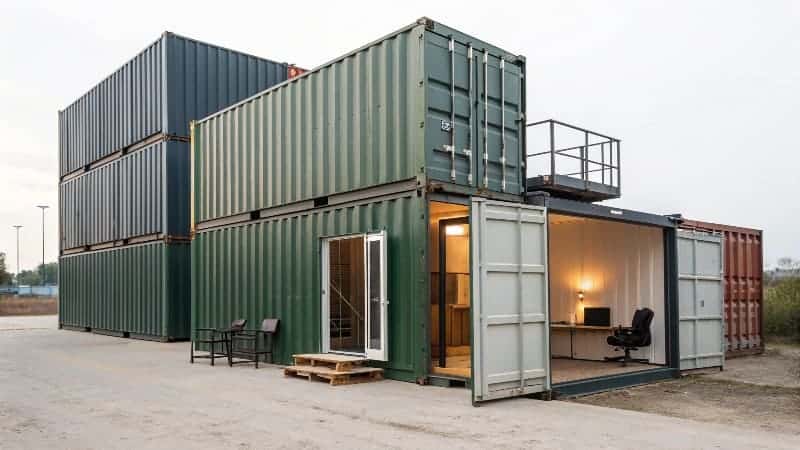
Containers are standardized steel transportation units designed for cargo shipping with ISO specifications and structural integrity for stacking, while prefabs are factory-built modular structures designed for specific functions like housing or offices, with containers emphasizing transport durability and prefabs prioritizing architectural functionality and finish quality.
Containers follow ISO specifications for global transport compatibility with standardized dimensions and corner fitting systems. Prefabs prioritize functional design for specific end-use applications including insulation, electrical, plumbing integrated during manufacturing process. Container construction emphasizes structural strength for shipping loads and weather resistance. Prefab construction focuses on occupancy comfort with architectural finishes and building system integration. Cost structures differ significantly with containers emphasizing durability while prefabs emphasize functionality.

Structural Comparison
Fundamental structural differences reflect the distinct purposes of containers versus prefab buildings.
| Structural Element | Shipping Container | Prefab Building | Design Priority | Performance Impact |
|---|---|---|---|---|
| Frame System | Corten steel | Various materials | Transport loads vs occupancy | Strength vs comfort |
| Wall Thickness | 2mm steel | Insulated panels | Weather protection vs thermal | Durability vs efficiency |
| Floor System | Marine plywood | Structural decking | Cargo loads vs live loads | Capacity vs comfort |
| Door Systems | Cargo doors | Architectural doors | Security vs accessibility | Function vs aesthetics |
| Window Provisions | None standard | Integrated design | Transport vs habitability | Cost vs livability |
Container structure prioritizes transport durability over occupancy comfort.
Manufacturing Approach
Production methods differ significantly between container and prefab manufacturing.
| Manufacturing Factor | Container Production | Prefab Production | Quality Focus | Cost Impact |
|---|---|---|---|---|
| Standardization | ISO compliance | Custom requirements | Uniformity vs customization | Scale vs flexibility |
| Assembly Method | Welded construction | Modular assembly | Permanent vs adaptable | Strength vs modification |
| Quality Control | Transport standards | Building codes | Durability vs habitability | Different metrics |
| Production Volume | High volume | Variable batch | Efficiency vs customization | Cost optimization |
| Certification | CSC maritime | Building permits | Transport vs occupancy | Regulatory compliance |
Container manufacturing focuses on transport durability while prefab emphasizes occupancy functionality.
Application Suitability
Different applications favor container versus prefab solutions based on specific requirements.
| Application Type | Container Advantages | Prefab Advantages | Selection Criteria | Market Preference |
|---|---|---|---|---|
| Temporary Storage | Weather resistance | Climate control | Duration/conditions | Containers |
| Site Offices | Security/mobility | Comfort/functionality | Usage requirements | Mixed preference |
| Residential Units | Cost/durability | Livability/aesthetics | Quality expectations | Prefab preferred |
| Retail Spaces | Unique appearance | Professional finish | Brand image | Application dependent |
| Emergency Housing | Quick deployment | Occupancy comfort | Speed vs comfort | Containers |
Application requirements determine optimal choice between container and prefab solutions.
What Are the Three Types of Containers?
The three main container types are dry van containers for general cargo, refrigerated containers (reefers) for temperature-sensitive goods, and specialized containers including tank, flat rack, and open-top variants for specific cargo requirements, each designed with distinct structural and functional characteristics.
Dry van containers represent 85% of global fleet designed for general cargo transport with standard dimensions and weatherproof enclosure. Refrigerated containers maintain controlled temperatures for perishable goods using integrated cooling systems and insulated construction. Specialized containers include tank containers for liquids, flat racks for oversized cargo, open-top units for bulk materials, and platform containers for heavy equipment. Each type serves specific shipping requirements with appropriate structural modifications and handling capabilities.
Dry Van Container Specifications
Standard dry van containers form the backbone of global containerized shipping.
| Specification | 20ft Standard | 40ft Standard | 40ft High Cube | 45ft High Cube |
|---|---|---|---|---|
| External Length | 20ft (6.1m) | 40ft (12.2m) | 40ft (12.2m) | 45ft (13.7m) |
| External Width | 8ft (2.4m) | 8ft (2.4m) | 8ft (2.4m) | 8ft (2.4m) |
| External Height | 8.5ft (2.6m) | 8.5ft (2.6m) | 9.5ft (2.9m) | 9.5ft (2.9m) |
| Payload Capacity | 28,230kg | 28,600kg | 28,600kg | 27,700kg |
| Cubic Capacity | 33.2m³ | 67.7m³ | 76.3m³ | 86.0m³ |
40ft high cube containers provide optimal volume efficiency for most cargo types.
Refrigerated Container Systems
Reefer containers maintain precise temperature control for perishable cargo transport.
| System Component | Function | Temperature Range | Power Requirements | Maintenance Needs |
|---|---|---|---|---|
| Refrigeration Unit | Primary cooling | -30°C to +30°C | 380-460V, 50/60Hz | Regular service |
| Insulation System | Temperature retention | Continuous protection | None | Periodic inspection |
| Air Circulation | Uniform distribution | Controlled airflow | Integrated power | Filter replacement |
| Monitoring Systems | Data logging | Continuous recording | Low power | Calibration |
| Backup Systems | Emergency operation | Limited duration | Battery/generator | Testing protocols |
Integrated refrigeration units provide reliable temperature control throughout shipping duration.
Specialized Container Categories
Specialized containers address specific cargo requirements beyond standard dry van capabilities.
| Container Type | Primary Use | Structural Features | Loading Method | Cargo Examples |
|---|---|---|---|---|
| Tank Containers | Liquid transport | Cylindrical tank | Top/bottom loading | Chemicals, food liquids |
| Flat Rack | Oversized cargo | Collapsible ends | Crane/forklift | Machinery, vehicles |
| Open Top | Bulk materials | Removable roof | Top loading | Scrap metal, grain |
| Platform | Heavy equipment | Flat deck | Side/end loading | Construction equipment |
| Ventilated | Air circulation | Ventilation ports | Standard doors | Coffee, cocoa |
Tank containers provide the highest specialization for liquid cargo transport requirements.
Market Distribution Analysis
Container type usage varies by trade routes and cargo characteristics.
| Trade Route | Dry Van Usage | Reefer Usage | Specialized Usage | Growth Trends |
|---|---|---|---|---|
| Trans-Pacific | 75% | 20% | 5% | Stable distribution |
| Trans-Atlantic | 80% | 15% | 5% | Slight reefer growth |
| Intra-Asia | 85% | 10% | 5% | Dry van dominant |
| Europe-Asia | 70% | 25% | 5% | Reefer expansion |
| Emerging Markets | 90% | 8% | 2% | Basic cargo focus |
Dry van containers maintain dominance across all major trade routes.
Conclusion
Collapsible containers feature foldable walls reducing storage volume by 75% while maintaining structural integrity when expanded for use, with collapsible and foldable being essentially synonymous terms describing volume reduction capability. Containers differ from prefabs as standardized transport units emphasizing ISO compliance and shipping durability, while prefabs prioritize architectural functionality and occupancy comfort with integrated building systems. Three main container types include dry van containers for general cargo representing 85% of fleet, refrigerated containers for temperature-sensitive goods with integrated cooling systems, and specialized containers including tank, flat rack, open-top variants for specific cargo requirements. Success in container applications requires understanding that collapsible designs address empty repositioning costs, structural priorities differ between transport and building applications, and container type selection must match cargo characteristics, with proper specification ensuring optimal performance across shipping, storage, and specialized transport requirements in global logistics operations.
