




What Are The Disadvantages Of Through-Floor Plumbing In Containers?
Through-floor plumbing in containers can weaken structural integrity, increase corrosion risk, complicate maintenance, and create insulation problems in cold climates. Cutting through the container floor also disrupts the original waterproof steel structure.
TRUSUS engineering insight: container plumbing is not simple interior work. It is a structural system redesign.
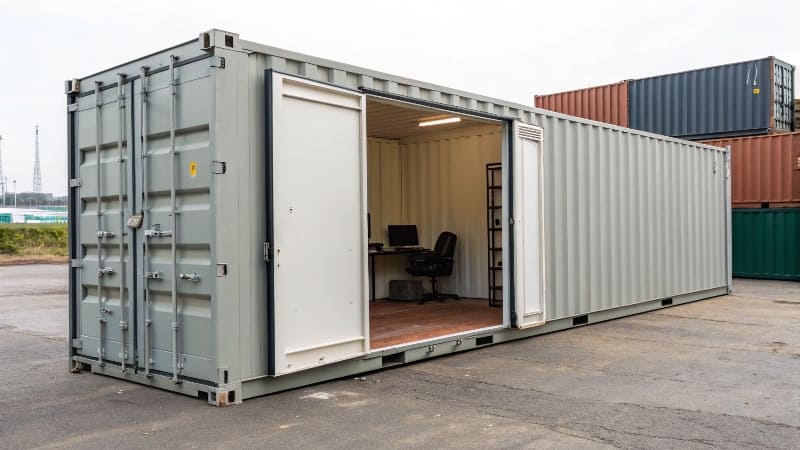
Many people enter container housing projects believing plumbing installation will work like a standard residential building.
But containers were originally designed as sealed transportation units, not living spaces.
The container floor relies on:
- Continuous steel structure
- Welded waterproof protection
- Load distribution strength
Once openings are cut into the floor for plumbing systems, several hidden problems appear.
Common Through‑Floor Plumbing Risks
| Problem | Result |
|---|---|
| Steel penetration | Corrosion risk increases |
| Structural openings | Reduced rigidity |
| Cold bridge formation | Condensation buildup |
| Limited access | Difficult repairs |
I often see moisture forming where pipes contact exposed steel surfaces.
That condensation slowly creates rust around the pipe penetrations.
Maintenance is another major challenge.
If a leak develops under the floor, repairs may require removing finished flooring and insulation layers.
In traditional buildings, plumbing usually integrates with foundations and service cavities.
Containers do not naturally provide those systems.
That is why successful container plumbing requires engineering coordination, not only installation work.
What PEX Tubing Is Essential For Container Modular Plumbing?
PEX tubing is essential in container modular plumbing because it offers flexibility, freeze resistance, corrosion resistance, and easier installation in tight spaces. Oxygen-barrier PEX or multilayer composite PEX is often preferred for long-term modular applications.
TRUSUS plumbing insight: material flexibility is critical in non‑standard container environments.
Recommended PEX Options
| PEX Type | Best Use |
|---|---|
| Standard PEX | Temporary installations |
| Oxygen‑barrier PEX | Long‑term residential systems |
| Multilayer composite PEX | High durability applications |
Container buildings behave differently from conventional structures.
They experience:
- Faster temperature changes
- Greater vibration during transport
- More movement stress
- Higher condensation risk
That is why rigid plumbing systems often create long‑term reliability problems inside containers.
PEX tubing became popular because its flexibility allows it to absorb movement and thermal expansion more safely.
Another major advantage is freeze resistance.
Unlike rigid metal pipes, PEX can tolerate limited expansion if water freezes inside the tubing.
This reduces the chance of catastrophic pipe failure in cold weather.
I also find that reducing connection points is extremely important in compact modular spaces.
Fewer fittings mean:
- Lower leak risk
- Faster installation
- Easier maintenance
As container housing evolves, plumbing systems are becoming less about basic utility connections and more about long‑term environmental adaptability.
Can You Connect Container Plumbing Directly To A City Sewer Line?
Yes, container plumbing can connect directly to a city sewer line, but the connection usually requires customized adaptation for elevation, slope, and inspection access. Containers rarely align perfectly with fixed municipal infrastructure systems.
TRUSUS infrastructure insight: connecting a container to city utilities is often an integration challenge, not a pipe challenge.
Common Sewer Connection Challenges
| Challenge | Typical Issue |
|---|---|
| Elevation mismatch | Drainage flow problems |
| Slope adjustment | Poor wastewater movement |
| External exposure | Freeze vulnerability |
| Access limitations | Difficult maintenance |
At first glance, sewer connection seems straightforward.
Many customers assume it is simply a matter of matching pipe sizes.
But municipal sewer systems are designed for permanent fixed buildings.
Containers are movable structures with highly variable placement conditions.
That creates several engineering complications.
The container floor height may not match the city sewer elevation.
Extra transition piping may be necessary to maintain proper drainage slope.
In cold regions, external sewer connections often become the weakest thermal point in the entire plumbing system.
Inspection access is another issue.
Local regulations may require:
- Cleanouts
- Inspection points
- Venting systems
- Service accessibility
I believe this is one reason why many container projects underestimate infrastructure costs.
The container itself may be affordable, but utility integration often requires significant engineering work.
Is Container Plumbing Frost-Proof In Sub-Zero Weather?
Container plumbing is not automatically frost-proof in sub-zero weather. Freeze protection depends on insulation design, pipe routing, heat tracing, and protection of exposed connection points.
TRUSUS thermal insight: frost resistance is a whole‑system issue, not only a pipe material issue.
High‑Risk Freeze Areas
| Location | Freeze Risk |
|---|---|
| Underfloor piping | Very high |
| Wall penetrations | High |
| Exterior connections | Very high |
| Unheated corners | Moderate |
One of the biggest misunderstandings in container housing is assuming insulated walls alone solve winter plumbing problems.
Containers naturally create thermal bridges because the entire structure is made from steel.
Cold transfers quickly through:
- Wall framing
- Floor structure
- Steel junctions
- Pipe penetrations
Even high‑quality PEX tubing cannot fully prevent freezing if the surrounding system lacks thermal protection.
Successful frost prevention usually requires multiple layers of protection:
- Continuous insulation
- Pipe placement inside conditioned zones
- Heat tracing systems
- Proper ventilation control
I have seen many projects where plumbing failures occurred not inside the walls, but at exterior transition points below the container.
Those exposed sections often experience the lowest temperatures and strongest wind exposure.
This is why cold‑climate container design must treat plumbing as part of the overall thermal engineering strategy.
The problem is not simply about pipes freezing.
It is about how the entire container interacts with climate conditions.
Conclusion
At TRUSUS, I see container plumbing evolving from basic utility installation into a full system integration challenge. Long‑term reliability depends on structural adaptation, thermal design, infrastructure compatibility, and coordinated engineering working together as one complete living system.
