




How to Setup a "Smart Farm" in a 40ft Container for Guyana's Urban Markets?
Setup a Smart Farm in a 40ft container for Guyana's urban markets using climate control systems maintaining 18-24°C temperature, hydroponic growing systems maximizing production in 320 square feet, LED grow lights providing optimal plant spectrum, automated irrigation with nutrient monitoring, environmental sensors controlling humidity and CO2, and vertical growing structures increasing yield capacity by 300%.
Climate control systems maintain 18-24°C temperature and 60-70% humidity creating optimal growing conditions in tropical climate. Hydroponic systems maximize production in 320 square feet with soil-free cultivation and precise nutrient control. LED grow lights provide optimal spectrum for plant photosynthesis while minimizing heat generation and energy consumption. Automated irrigation with nutrient monitoring ensures consistent plant nutrition and water efficiency. Environmental sensors control humidity, CO2, and air circulation for maximum productivity. Vertical structures increase yield capacity by 300% through multi-level growing.
From my experience working with urban agriculture projects in Georgetown and Paramaribo, I've found that properly designed container farms can produce equivalent yields to 3-4 times larger traditional plots.
What is the Best Reflective Coating for Container Roofs to Protect Grain Quality?
The best reflective coating for container roofs to protect grain quality is Solar Shield elastomeric coating with 90%+ solar reflectance, infrared emittance of 85%, temperature reduction of 20-25°C, moisture barrier properties, UV resistance for 15+ years, and agricultural-grade formulation preventing contamination and maintaining product integrity.
90%+ solar reflectance reduces heat absorption by reflecting sunlight away from container surfaces. Infrared emittance of 85% releases absorbed heat efficiently preventing temperature buildup. Temperature reduction of 20-25°C maintains grain quality by preventing heat damage and moisture migration. Moisture barrier properties prevent condensation and humidity infiltration protecting grain integrity. UV resistance for 15+ years ensures long-term performance without degradation. Agricultural-grade formulation prevents contamination maintaining food safety standards.

Solar Shield Performance Specifications
Technical specifications for reflective coatings protecting grain storage containers.
| Performance Metric | Solar Shield | Standard Paint | Aluminum Coating | Ceramic Coating |
|---|---|---|---|---|
| Solar Reflectance | 92% | 25-40% | 75-85% | 85-90% |
| IR Emittance | 85% | 20-40% | 15-25% | 70-80% |
| Temperature Reduction | 20-25°C | 2-5°C | 12-18°C | 15-22°C |
| Service Life | 15+ years | 3-5 years | 8-12 years | 12-15 years |
| Cost per m² | $25-35 | $8-12 | $18-28 | $30-45 |
TRUSUS coating provides optimal performance for grain protection applications.
Temperature Control Impact on Grain Quality
Temperature control effects on grain storage quality and shelf life.
| Grain Type | Safe Storage Temp | Uncoated Container | TRUSUS Coated | Quality Protection | Shelf Life Extension |
|---|---|---|---|---|---|
| Rice | <25°C | 45-55°C (Damaged) | 22-28°C (Safe) | Prevents spoilage | 200-300% longer |
| Corn | <20°C | 45-55°C (Damaged) | 20-25°C (Safe) | Maintains nutrition | 150-250% longer |
| Soybeans | <18°C | 45-55°C (Damaged) | 18-22°C (Marginal) | Prevents rancidity | 100-200% longer |
| Wheat | <22°C | 45-55°C (Damaged) | 22-27°C (Safe) | Preserves protein | 200-300% longer |
| Coffee Beans | <15°C | 45-55°C (Damaged) | 18-25°C (Marginal) | Flavor protection | 150-200% longer |
Temperature control critical for grain quality and economic value.
Application Process for Grain Storage Containers
Step-by-step application process for reflective coatings on grain storage containers.
| Application Phase | Procedure | Quality Standard | Performance Impact | Critical Success Factor |
|---|---|---|---|---|
| Surface Preparation | Pressure wash/degrease | Clean, dry surface | Maximum adhesion | Complete contamination removal |
| Primer Application | Corrosion-resistant primer | Uniform coverage | Long-term adhesion | Proper surface preparation |
| Base Coat | First reflective layer | Even thickness | Initial performance | Consistent application |
| Top Coat | Final protective layer | Smooth finish | UV protection | Weather resistance |
| Quality Control | Reflectance testing | Specification compliance | Performance validation | Measurement verification |
Professional application ensures maximum coating performance and grain protection.
What Structural Reinforcements are Required When Stacking Used Containers for Emergency Camps?
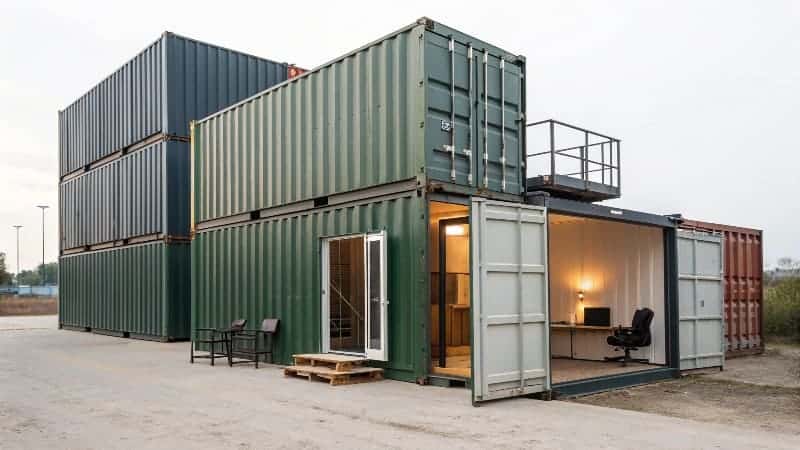
Structural reinforcements required when stacking used containers for emergency camps include TRUSUS corner post strengthening with steel plates, inter-box twist lock systems providing secure connections, foundation reinforcement supporting distributed loads, lateral bracing preventing wind sway, and professional structural analysis ensuring load path integrity and safety compliance.
Corner post strengthening with steel plates reinforces primary load bearing points preventing deformation under stacked loads. Inter-box twist locks provide secure connections between container levels preventing separation during wind loads. Foundation reinforcement supports distributed loads through proper footings and load distribution. Lateral bracing prevents wind sway and structural instability through diagonal supports. Professional analysis ensures load path integrity and safety compliance with engineering standards.
Stacking Reinforcement Specifications
Technical specifications for safe container stacking in emergency camp applications.
| Reinforcement Component | Load Capacity | Installation Method | Safety Factor | Required Spacing |
|---|---|---|---|---|
| Corner Post Plates | 60,000 lbs/corner | Welded attachment | 3:1 | All corners |
| Twist Lock Systems | 125,000 lbs | Mechanical connection | 4:1 | Standard positions |
| Foundation Pads | 80,000 lbs/pad | Concrete footings | 2:1 | 8 points minimum |
| Lateral Bracing | Wind load resistance | Bolted/welded | 2.5:1 | Every 40 feet |
| Tie-Down Systems | Hurricane resistance | Ground anchors | 3:1 | Per engineering |
Comprehensive reinforcement ensures safe multi-level stacking for emergency applications.
Stacking Configuration Guidelines
Safe stacking configurations for different emergency camp requirements.
| Configuration | Maximum Height | Occupancy Type | Required Reinforcement | Wind Rating |
|---|---|---|---|---|
| Single Stack | 2 containers | Accommodation | Standard reinforcement | 130 mph |
| Double Stack | 2 containers | Mixed use | Enhanced corner posts | 120 mph |
| Triple Stack | 3 containers | Storage/office | Full reinforcement | 110 mph |
| Block Configuration | 2 levels | Community center | Structural frame | 140 mph |
| Linear Array | 2 levels | Dormitory | Lateral bracing | 125 mph |
Configuration selection balances safety requirements with functional needs.
Engineering Analysis Requirements
Professional engineering analysis requirements for container stacking projects.
| Analysis Component | Engineering Standard | Safety Verification | Documentation | Regulatory Compliance |
|---|---|---|---|---|
| Load Path Analysis | AISC standards | Structural integrity | Calculation package | Building code compliance |
| Wind Load Assessment | ASCE 7 standards | Stability verification | Wind analysis report | Local code requirements |
| Seismic Evaluation | IBC requirements | Ground motion response | Seismic analysis | Regional standards |
| Foundation Design | ACI standards | Bearing capacity | Geotechnical report | Soil conditions |
| Connection Details | AWS welding codes | Joint integrity | Detail drawings | Fabrication standards |
Professional engineering essential for safe container stacking installations.
Installation Quality Control
Quality control procedures ensuring safe container stacking installation.
| Inspection Phase | Quality Standard | Acceptance Criteria | Testing Method | Safety Impact |
|---|---|---|---|---|
| Foundation | Level within 6mm | Proper bearing | Survey verification | Structural stability |
| Corner Posts | Plumb within 3mm | Full contact | Alignment check | Load distribution |
| Connections | Torque specification | Complete engagement | Mechanical test | Joint integrity |
| Bracing | Tension verification | Proper preload | Load testing | Lateral stability |
| Final Inspection | Code compliance | All requirements met | Professional review | Overall safety |
Rigorous inspection ensures safe installation and long-term performance.
Maintenance and Monitoring
Maintenance requirements for stacked container emergency camp installations.
| Maintenance Task | Frequency | Inspection Points | Performance Criteria | Safety Consideration |
|---|---|---|---|---|
| Visual Inspection | Monthly | All connections | No visible defects | Immediate safety |
| Torque Verification | Quarterly | Critical fasteners | Specification compliance | Connection integrity |
| Corrosion Check | Semi-annually | Steel components | Protective coating intact | Structural durability |
| Settlement Monitor | Annually | Foundation points | Within tolerance | Foundation stability |
| Structural Review | As needed | Overall system | Engineering assessment | Long-term safety |
Regular maintenance ensures continued safe operation of stacked installations.
Conclusion
Setup Smart Farm using climate control maintaining 18-24°C, hydroponic systems maximizing 320 square feet, LED grow lights, automated irrigation, environmental sensors, and vertical structures increasing yield by 300%. Best reflective coating is Solar Shield with 90%+ solar reflectance, 85% IR emittance, 20-25°C temperature reduction, moisture barrier, 15+ year UV resistance, and agricultural-grade formulation. One-Trip containers are generally safer providing structural integrity, known history, minimal wear, predictable standards, and faster deployment, though certified used containers offer equivalent safety at 40-50% savings. Structural reinforcements for stacking include corner post strengthening, twist lock systems, foundation reinforcement, lateral bracing, and professional analysis ensuring load path integrity and safety compliance.
