




How Is a Container Constructed?
A standard shipping container is built from high-strength corten steel frames, corrugated steel panels, and a solid wood or bamboo floor, all welded and sealed to form a secure, rigid structure.
TRUSUS insight: every container is not just metal—it’s a modular precision structure.
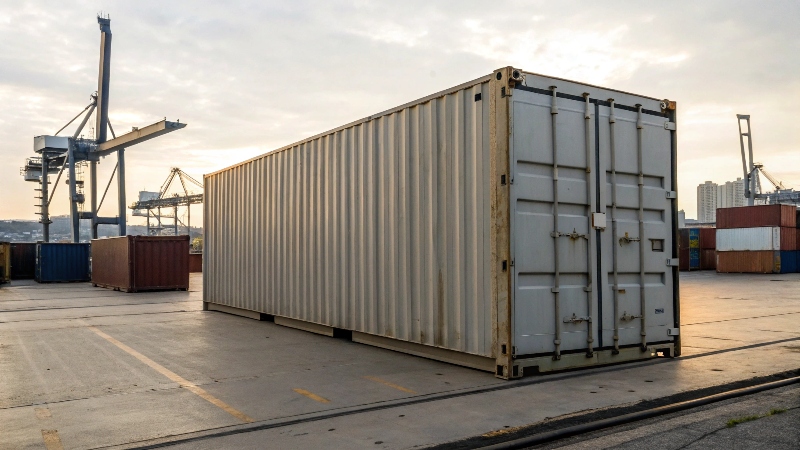
The design focuses on standardized dimensions, stacking strength, and protection against corrosion during transport and storage. This standardization makes containers reliable across global supply chains.
What Is the Construction of a Shipping Container?
Each container is made of a steel corner post and rail framework, with corrugated side and roof panels, cross members, and reinforced flooring. All components are welded to ensure load-bearing capacity and watertight integrity.
TRUSUS engineering insight: container strength comes from its frame geometry, not its wall thickness.

Container Structural Breakdown
| Component | Material | Function |
|---|---|---|
| Corner Posts | Corten Steel | Main load-bearing verticals |
| Top & Bottom Rails | Steel Beam | Distribute load horizontally |
| Corrugated Panels | Corten Steel Sheet | Add stiffness and protect cargo |
| Cross Members | Galvanized Steel | Support floor planks |
| Floor | Hardwood or Bamboo Plywood | Provide internal base strength |
| Door & Hinges | Double-steel with gasket | Ensure weather-tight closure |
Structural Logic
Containers are built as monocoque systems, where strength is shared between frame and skin. The corrugated design resists compression, twisting, and stacking while keeping overall weight manageable.
What Is FCL and LCL?
FCL stands for Full Container Load, meaning one shipper fills the entire container. LCL means Less than Container Load, where several shippers share space inside one container.
logistics insight: both options balance cost and control—FCL for efficiency, LCL for flexibility.
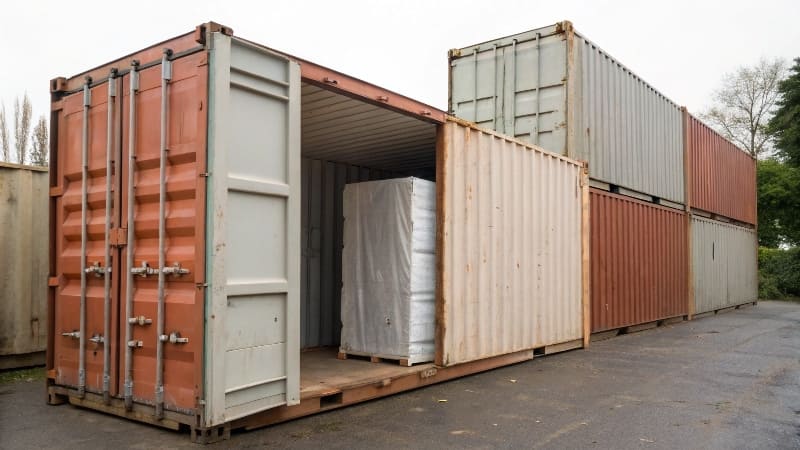
Logistics Comparison
| Term | Description | Best Use |
|---|---|---|
| FCL (Full Container Load) | One consignment fills container | Large volume or high-value goods |
| LCL (Less than Container Load) | Multiple shipments share space | Small consignments or cost-sharing |
| Mixed Freight | Combination of both | Seasonal or varied supply chains |
Operational Differences
| Feature | FCL | LCL |
|---|---|---|
| Handling | Minimal | Frequent (during consolidation) |
| Cost Efficiency | Better per unit | Better for small loads |
| Cargo Safety | Higher (sealed) | Moderate (shared) |
| Delivery Speed | Faster | Slightly slower |
Choosing between FCL and LCL depends on shipment size, trade frequency, and budget.
What Is a Container Conversion?
A container conversion transforms a shipping container into a habitable or functional space, such as an office, café, or portable housing module. It uses the existing steel structure as the main framework and upgrades insulation, ventilation, and finishing systems.
TRUSUS design insight: container conversions give industrial strength a second life as flexible architecture.
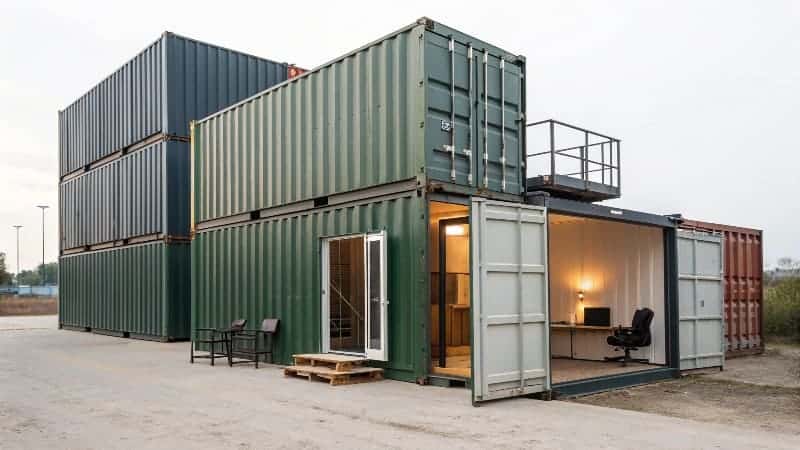
Conversion Process
| Step | Operation | Purpose |
|---|---|---|
| 1 | Structural Assessment | Ensure no rust or frame weakness |
| 2 | Cutting and Framing | Add doors, windows, or combined units |
| 3 | Insulation and Lining | Thermal and acoustic comfort |
| 4 | Plumbing and Electrical | Functional adaptation |
| 5 | Finishing and Painting | Aesthetic and corrosion resistance |
Benefits of Conversion
| Feature | Advantage |
|---|---|
| Pre-engineered frame | No need for new structure |
| Quick assembly | Shorter construction cycle |
| Modular design | Easy transport and expansion |
| Cost efficiency | Lower compared to traditional builds |
| Sustainable reuse | Supports circular economy goals |
Converted containers showcase how engineering precision can merge with creative design, transforming logistics infrastructure into living or working space.
Conclusion
Shipping containers are masterpieces of standardized structural engineering. Their steel skeletons carry global trade and evolve into modular spaces through conversion. TRUSUS sees each container not as a box, but as a mobile system of durability, efficiency, and endless possibilities—proof that industrial logic can shape beautiful, practical spaces around the world.
